IUCN/SSC Otter Specialist Group Bulletin

|
IUCN/SCC Otter Specialist Group Bulletin Volume 27 Issue 1 Pages 1 - 57 (January 2010) Citation: Chadwick, E.A. and Sherrard-Smith, E. (2010). Pregnancy among Otters (Lutra lutra) found Dead in England and Wales: Foetal Development and Lack of Seasonality. IUCN Otter Spec. Group Bull. 27 (1): 33 – 41 Pregnancy among Otters (Lutra lutra) found Dead in England and Wales: Foetal Development and Lack of Seasonality Elizabeth Chadwick1 and Eleanor Sherrard-Smith1 1Cardiff School of Biosciences, Cardiff University, Museum Avenue, Cardiff, CF10 3AX, UK. Email: Chadwickea@cardiff.ac.uk |
 |
|
Abstract:In some parts of its range, the Eurasian otter (Lutra lutra) is reported to exhibit seasonal breeding, but in England and Wales breeding is thought to occur throughout the year. Here, we test that assumption using data from 206 female otters found dead in England or Wales between 1992 and 2008. Pregnant females were found in all months except June; no evidence for seasonality was found. The mean number of implantations (based on placental scarring) was 2.36. Information on foetal development of otters is limited; here we use foetal otters found in utero to describe development, and make a call for information from other researchers. |
| Keywords: Reproduction; Lactation; Foetus; Placental scarring; Road-traffic Casualty |
| Française | Español |
INTRODUCTION
Seasonal breeding in the Eurasian otter Lutra lutra is recorded in some parts of its range, for example Kruuk et al. (1987) observed a breeding season for Shetland otters in June, whilst Heggberget and Christensen (1994) described a late summer-autumn breeding season for otters in Norway. In England and Wales however, it is suggested that breeding can occur throughout the year (e.g. Stephens, 1957; Mason and Macdonald, 1986). In captivity otters can come into oestrous at any time of year (Reuther, 1993), but it has been suggested that otters in the wild may exhibit seasonality in areas where either food availability or climate act as seasonally variable constraints (Liles, 2003). Often, records of seasonality are based on estimations of birth date from cubs seen in the wild, e.g. Harris (1968). Records of pregnancy in otters found dead have also been used to suggest seasonality (Heggberget and Christensen, 1994; Hauer et al., 2002).
Here, we present the results of reproductive assessment of 206 female otters found dead in England or Wales between 1992 and 2008. We look for evidence of seasonality, and describe foetal development.
ANIMALS, MATERIALS AND METHODS
Since 1992, otters found dead in Wales and much of England have been sent for post mortem examination to Cardiff University Otter Project (CUOP, www.otterproject.cf.ac.uk); since 2007, otters from the whole of England and Wales have been sent to CUOP. During examination, females are categorised as juvenile, sub-adult or adult, based on size and reproductive status (Chadwick, 2007). Adult (sexually mature) females are further described as pregnant, lactating or quiescent, where quiescent females are those that are not currently pregnant or lactating, but show evidence of previous reproduction (thickened uteri, placental scarring and / or protruding nipples). Chi-squared tests were used to test whether pregnancy occurred with equal frequency in four seasons (Dec-Feb, Mar-May, June-Aug, Sept-Nov).
Since changes in project management in 2004, post mortem procedures have been modified to include a record of the presence or absence of placental scarring, routine measurement of uteri and foetuses (uterus horn length and weight; foetus crown-rump length, total and tail length, and foetus weight), and a photographic record of all foetuses. Prior to this, records were inconsistent. Log10-transformed uterus weights of pregnant, lactating and quiescent females were compared using a one-way ANOVA although the test had restricted sensitivity because of unequal group sizes. Although we found no published literature attempting to age foetal otters, the gestation period (61-63 days, Stephens, 1957) is the same as that for dogs (61 days, Pretzer, 2008). Descriptions of canine development (Pretzer, 2008) and a plot of crown-rump length by age (Kähn, 2004) were used to approximate days of gestation and thereby predict birth date.
RESULTS
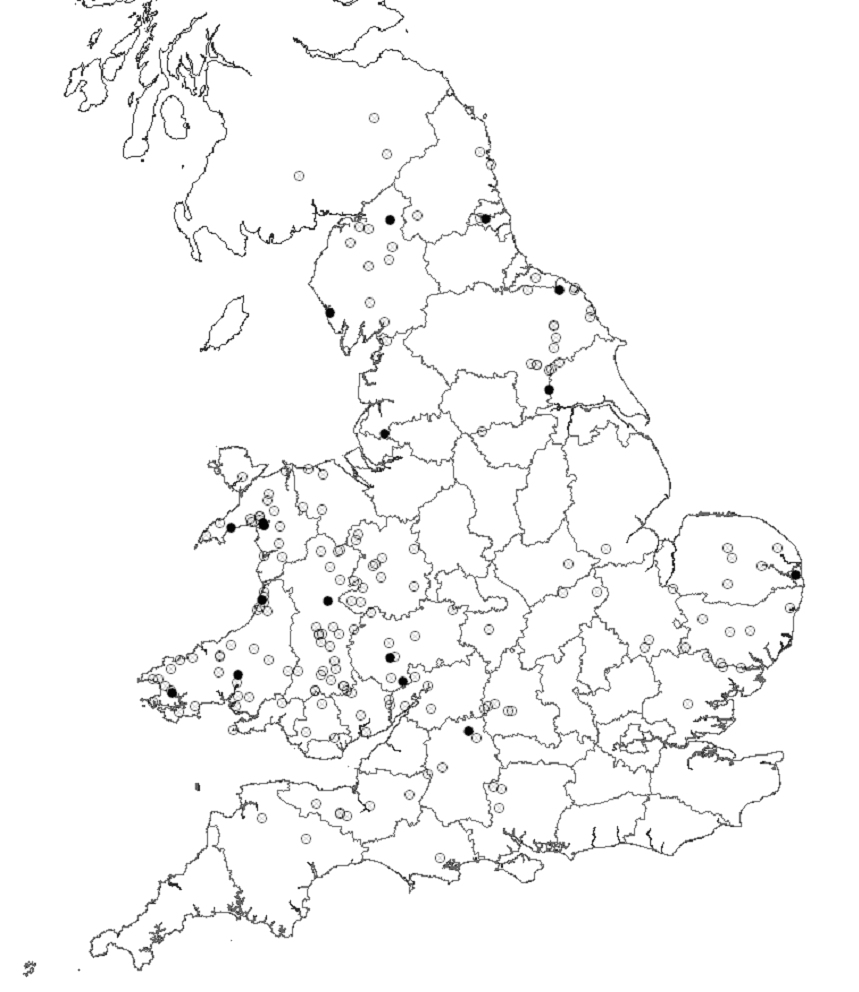
Since 1992, reproductive status has been assessed for 206 adult females (Figure 1). Of these, 19 have been pregnant (9.2%), and 49 lactating (23.8%). Twelve females had convoluted uteri, these individuals were not lactating and were omitted from the analyses; convolutions may indicate early stage pregnancy (Simpson, 1998) but in these cases this was uncertain. If included in our totals, then the percentage pregnant increases to 15%. The number of foetuses present was recorded in 18 cases; of these, there were six single foetuses, nine pairs, and three triplets.
 |
| Figure
1. Distribution of females collected. Filled circles indicate pregnant females; all other females are shown with open circles. (click for larger version) |
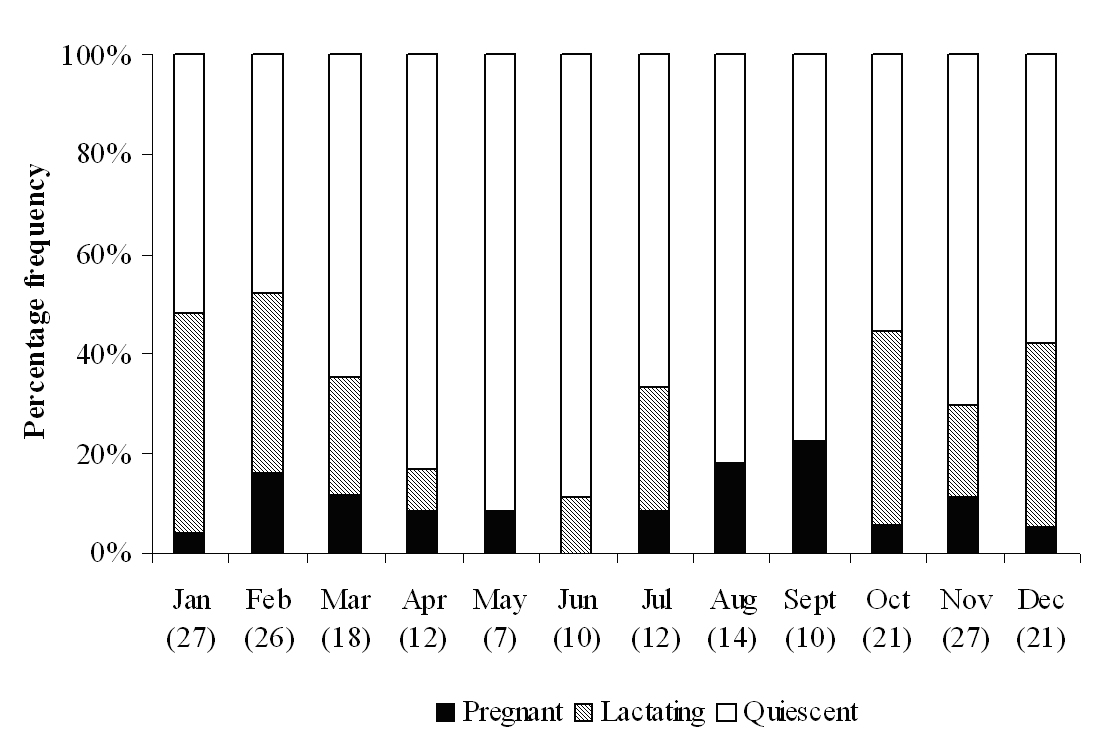
Pregnancy has been observed in every month apart from June, and lactation in all months apart from May, August and September (Figure 2). It should be noted that sample size is lowest in May, followed by June and September. There was no significant difference in the number of pregnancies per season (χ2= 1.42105; df = 3; P=0.701). However this result is interpreted with caution due to the low sample number (n = 19 pregnant females for which month was also recorded). Prediction of birth month was possible in eleven cases, where an accurate date of death and foetal morphometry were both recorded. This suggested births in months February to May, and October to December, with no births predicted in June-September. Data were too few to perform statistical analyses.
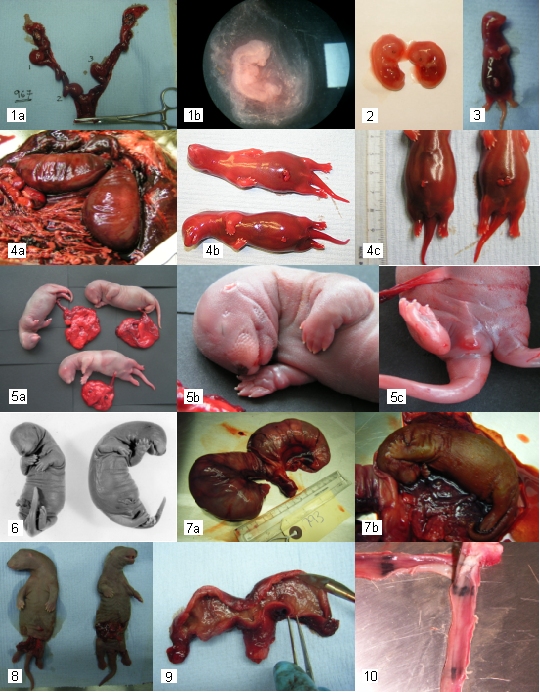
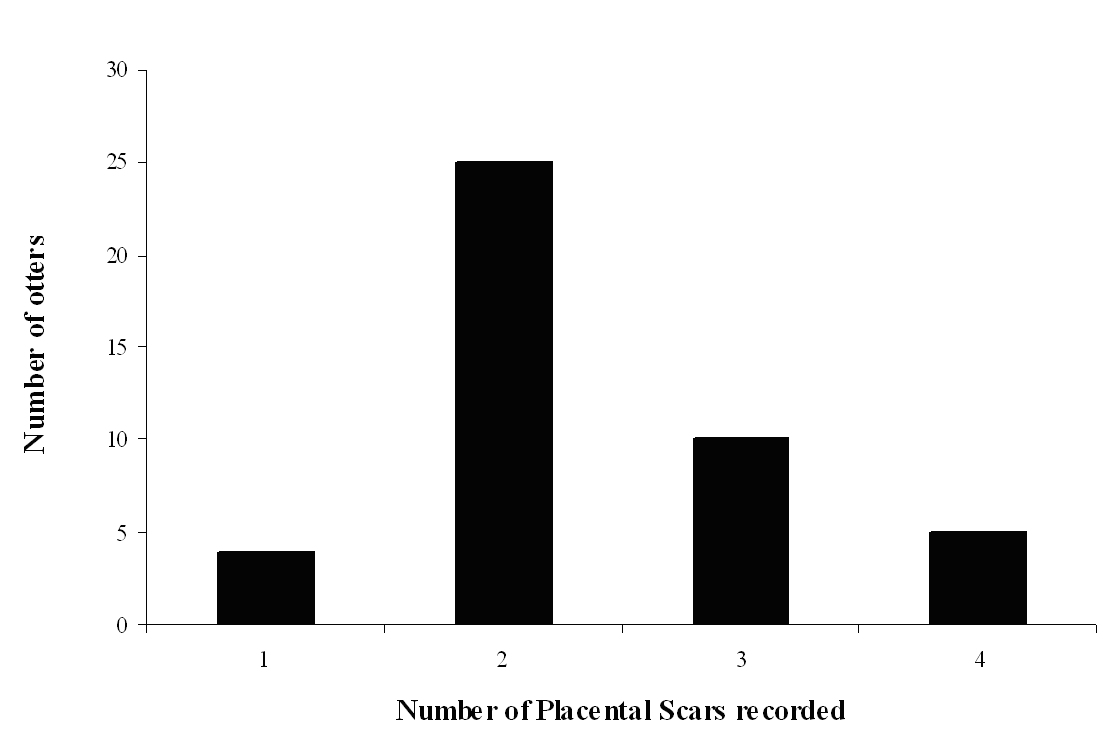
Since 2004, the uteri from 82 lactating or quiescent females have been screened for placental scarring (for illustration see Figure 3.10). Placental scarring was observed in 15/20 (75%) lactating females, and 38/62 (61%) quiescent females. Placental scarring was found in every month of the year. The mean number of placental scars was 2.36 with a range of 1 - 4 (Figure 4).
 |
| Figure
3. Foetal development and the appearance of the uterus (1) Female 967; (a) uterus at an early stage of pregnancy; distinct ‘pockets’ hold each of 3 foetuses; (b) miniscule (c. 5mm) foetus. (2) Female 557; fore-limbs have begun to form. (3) Female 902; fore- and hind-limbs apparent. (4) Female 763; (a) swollen uterus shown within body cavity; (b) claws formed but hairless; (c) close-up of the anogenital area, foetus appears to be male. (5) Female 1302; (a) 3 kits with placentas still attached; (b) close-up showing hair is present but not pigmented; (c) close-up of anogenital area, kit appears to be male. (6) Female 12; well developed foetuses. (7) Female 793; (a) uterus; (b) kit in uterus, hair and pigmentation apparent. (8) Female 906; hair present and pigmented. (9) Female 1104; swollen uterus but no kits; female was lactating – assumed post-parturition. (10) Female 735; placental scarring, evidence of 3 previous implantations. For further details see Table 1. (click for larger version) |
|
|
||||||||
| Table 1: Details of mother and foetuses shown in Figures 3 and 5. ‘Photo’ reference number refers to the numbered photograph in Figure 3. UWCref refers to the code number given to each otter examined, and is marked next to the relevant data points in Figure 5. | ||||||||
|
|
||||||||
| Photo | Details of mother | Details of foetus(es) (all weights in grams, lengths in mm’s) |
||||||
|
UWCref |
Date found |
n foetuses |
Horn |
Weight |
Crown-rump length |
Tail-length |
Total length |
|
| 6 | 12 | 1994 | 2 | L | 60 | 50 | 180 | |
| R | 56.8 | 48 | 160 | |||||
| none | 221 | May 1997 | 1 | R | 95.4 | 85 | 55 | 210 |
| 2 | 557 | Feb 2003 | 2 | |||||
| none | 564 | Feb 2003 | 2 | L | 0.93 | 26 | ||
| R | 0.93 | 24 | ||||||
| none | 686 | Oct 2004 | 1 | R | 70.5 |
|
55 | |
| 4 | 763 | Sept 2005 | 2 | L | 22.17 | 28 | 113 | |
| R | 22.17 | 29 | 115 | |||||
| 7 | 793 | Nov 2005 | 2 | L | 91 | 120 | 60 | 195 |
| R | 83.2 | 100 | 58 | 188 | ||||
| 3 | 902 | Feb 2007 | 1 | L | 93.45 | 60 | 20 | 83 |
| 8 | 906 | Feb 2007 | 2 | L | 55.69 | 125 | 51 | 191 |
| R | 43.7 | 115 | 49 | 181 | ||||
| 1 | 967 | Sept 2007 | 3 | R | c.5 | |||
| R | c.5 | |||||||
| L | c.5 | |||||||
| 5 | 1302 | Mar 2009 | 3 | R | 76.998 | 116 | 49 | 176 |
| L | 68.598 | 110 | 49 | 172 | ||||
| L | 74.201 | 103 | 50 | 176 | ||||
|
|
||||||||
 |
| Figure
4. Frequency distribution of placental scar counts (click for larger version) |
Uterus weight was significantly greater in pregnant females (after removal of foetuses) compared to lactating and quiescent females (Mean uterus weight 36.59 ± 27.9g [pregnant], 7.71g ± 9.4g [lactating] and 5.11 ± 3.7g [quiescent]; F = 29.60, df = 2, P < 0.001). Lactating females had on average heavier uteri than those of quiescent females but differences were not statistically significant.
Stages of foetal development and other features of note are recorded photographically (Figure 3.1 to 3.10). Foetal crown-rump lengths measured to date range from <5mm to 125mm (Table 1). An attempt to fit a foetal growth curve has been made using data from 12 foetuses (from 7 pregnancies) for which weight and crown-rump and/or total foetal length have been recorded (Figure 5). Crown-rump lengths are commonly reported in the literature (possibly because most foetal measurements are taken using ultrasonography, thereby precluding straight lengths). Total (straight) lengths were additionally used because crown-rump length can vary depending on the curvature of the foetus, whereas straight lengths provide a consistent comparison. In fitting the curves, data from multiple foetuses taken from the same female were averaged.
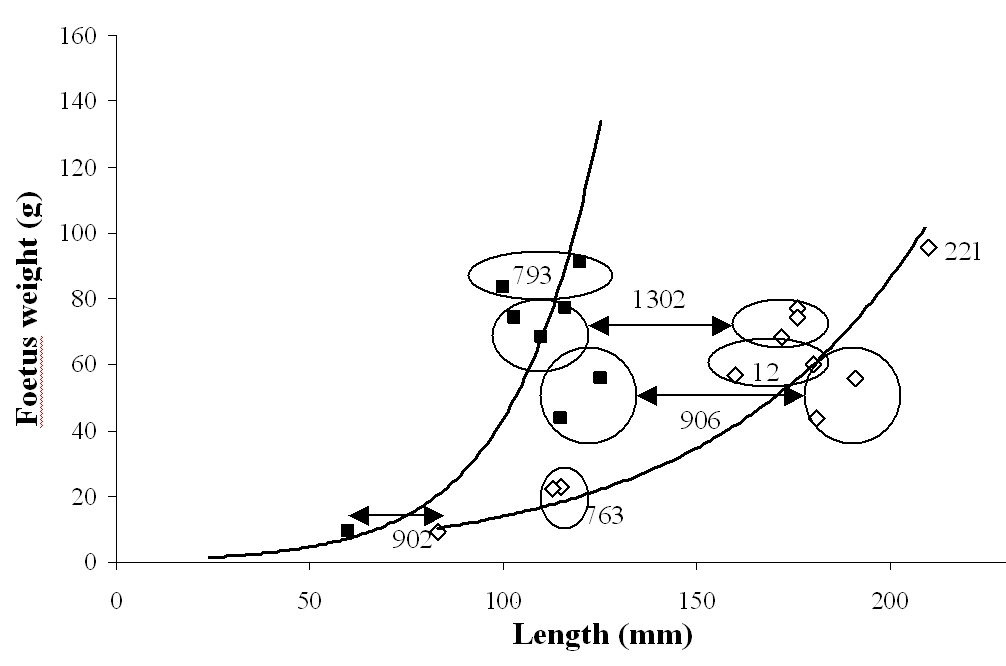
The growth curves shown can be described using: foetus weight = 0.4845e0.045(Crown-rump length) (R2 = 0.8587) and foetus weight = 2.2423e0.0183(Total length) (R2 = 0.9354).
In most cases foetuses appeared to be male (based on the distance between the anus and the genital papilla). Male and female foetuses were recorded in two cases (UWC Ref 906 and 793); in both cases the female was the smaller of the pair. Both foetuses recovered from otter 906 were damaged across the posterior end; this may explain their lower than expected weight (Figure 5).
DISCUSSION
Our data show no clear evidence of breeding seasonality in England and Wales, supporting previous studies (Stephens, 1957; Mason and Macdonald, 1986; Simpson, 2007). From estimates of birth month, it appeared that births were less common in the summer, but this should be treated with caution due to low sample size and potential inaccuracies introduced by basing estimates on canine foetal development curves. In a similar study (Simpson, 2007), also based in the UK, births were predicted in every month of the year except March. It seems likely that seasonality in locations such as Norway (Heggberget and Christensen, 1994), Denmark (Elmeros and Madsen, 1999) and Sweden (Erlinge, 1967) is due to a more marked seasonality in resources. It remains possible that seasonal breeding occurs in some parts of the UK, but given the small sample size it is not possible to separate data by region.
The young have been observed to begin leaving the mother at 10 months on the Shetland Isles, but may stay with her for longer (Kruuk, 2006); the young are weaned at around 15 weeks (Hancox, 1992). As pregnancies are observed in most months, it is unsurprising that lactation was observed throughout the year.
The maximum number of foetuses retained from a single female was 3, but most commonly (9/18 incidences) 2 foetuses were found. Mean litter size was 1.83. Similar litter size estimates have been reported in Belarus (Sidorovich, 1991), Germany (Ansorge et al., 1997) and Denmark (Elmeros and Madsen, 1999). Litters of up to six cubs have been observed (Harris, 1968) although this is rare. Broekhuizen et al.(2007) discuss the possibility that ovulation of six ova may not be uncommon but prenatal loss of foetuses limits litter size. Here however, the mean number of placental scars (2.36) was little higher than the mean number of foetuses (1.83).
Placental scars are thought to remain for at least 3 months post pregnancy (Elmeros and Madsen, 1999) but subsequently fade and disappear (Heggberget and Christensen, 1994). Occasionally otters were received showing multiple placental scars with pigmentation at various stages, possibly indicating a second pregnancy after a failed first one. The significant increase in weight of uteri in pregnant females is expected as oestrogen stimulates the growth of the uterine muscle mass required for foetal delivery.
Eurasian otters have a 61-63 day gestation period (Stephens, 1957). There is little information in the literature on foetal development in Eurasian otters. Reuther (1999) established Eurasian otter cubs have a mean birth weight of approximately 100g indicating that in a few cases (UWC Ref 221, 793 and 1302) females were close to delivery. From our observations, hair was first seen at foetal weights of 68g. Female foetuses were not recorded at weights less than c.44g (and in this case the foetus was damaged and the weight may therefore be underestimated). In dogs, gonadal appearance remains undifferentiated until after 30 days of gestation (Pretzer, 2008); it is not clear at what point male and female otters become distinct in appearance. We hope to use molecular analysis to accurately sex foetuses from our archive, so that we can establish whether those at earlier stages with male appearance are in fact female. We would also be keen to receive information or photographs of foetal development from other researchers.
Acknowledgements - Thank you to the Environment Agency for their contribution toward funding this project. Thank you for the support and feedback of Eleanor Kean, and for the French and Spanish translations of the abstract provided by Muriel Alix and Sonia Valladares respectively.
REFERENCES
Ansorge, H., Schipke, R., Zinke, O. (1997). Population structure of otters, Lutra lutra. Parameters and model for Central European region. Z. Säugetierkd. 62: 143-151.
Broekhuizen, S., Lammertsma, D.R., Müskens, G.J.D.M. (2007). Re-mating in otter (Lutra lutra). Lutra 50(2): 135-139.
Chadwick, E.A. (2007). Post mortem study of otters in England and Wales 1992-2003. Environment Agency Science Report SC010065/SR
Elmeros, M. and Madsen, A.B. (1999). On the reproduction biology of otters (Lutra lutra) from Denmark. Z. Säugetierkd. 64: 193-200.
Erlinge, S. (1967). Home range of the otter Lutra lutra L. in southern Sweden. Oikos 18: 186-209.
Hancox, M. (1992). Some Key Factors in Breeding, Conservation, and Sociology of Otters IUCN Otter Spec. Group Bull. 7: 2 - 4.
Harris, C.J. (1968). Otters: A study of the recent Lutrinae. Weidenfeld and Nicolson, London.
Hauer, S., Ansorge, H. and Zinke, O. (2002). Reproductive performance of otters Lutra lutra (Linnaeus, 1758) in Eastern Germany: low reproduction in a long-term strategy. Biol. J. Linn. Soc. 77(3): 329-340.
Heggberget, T.M. and Christensen, H. (1994). Reproductive Timing in Eurasian Otters on the Coast of Norway. Ecography 17(4): 339-348.
Kähn, W. (2004). Veterinary foetal ultrasonography. Schlütersche Verlagsgesellschaft mbH & Co, Hannover. Special Edition, reprint from 1994. English translation and revision, EM Kenney and D Volkmann.
Kruuk, H., Conroy, J.W.H. and Moorhouse, A. (1987). Seasonal reproduction, mortality and food of otters (Lutra lutra ) in Shetland. Symposium of the Zoological Society of London 58: 263-278.
Kruuk, H. (2006). Otters: Ecology, behaviour and conservation. Oxford University Press.
Liles, G. (2003). Otter Breeding Sites: Conservation and Management. Conserving Natura 2000 Rivers Conservation Techniques Series No. 5
Mason, C.F. and Macdonald, S.M. (1986). Otters: Ecology and Conservation. Cambridge, UK: Cambridge University Press.
Pretzer, S.D. (2008). Canine embryonic and fetal development: A review. Theriogenology 70: 300-303.
Reuther, C. (1993). Lutra lutra (Linnaeus, 1758) – Fischotter. In: Niethammer, J., Krapp, F. (eds.) Handbuch der Säugetiere Europas, Band 5: 907-961. Aula Verlag, Wiesbaden, Germany.
Reuther, C. (1999). Development of weight and length of Eurasian otter (Lutra lutra) cubs. IUCN Otter Spec. Group Bull. 16(1).
Sidorovich, V.E. (1991). Structure, reproductive status and dynamics of the otter population in Byelorussia. Acta Theriol. 36: 153-161.
Simpson, V.R. (1998). A Post Mortem Study of Otters (Lutra lutra) Found Dead in South West England. Environment Agency R&D Technical Report W148.
Simpson, V.R. (2007). Health status of otters in southern and south west England 1996-2003. Environment Agency Science Report SC010064/SR1.
Stephens, M.N. (1957). The Otter Report. The Universities Federation for Animal Welfare, Potters Bar, Herts.
Cardiff University Otter Project: www.otterproject.cf.ac.uk
Résumé : Des Loutres (Lutra lutra) Pleines Trouvées Mortes En Angleterre Et Au Pays De Galles: Développement Fœtal Et Absence De Reproduction Saisonnière
Dans certaines régions, la loutre eurasienne (Lutra lutra) est connue pour avoir une période de reproduction saisonnière. Cependant, en Angleterre et au Pays de Galles, la période de reproduction semble s’étendre sur toute l’année. Dans cette étude, nous testons cette hypothèse en utilisant des données provenant de 206 femelles trouvées mortes en Angleterre et au Pays de Galles entre 1992 et 2008. Des femelles pleines ont été trouvées tout au long de l’année à l’exception du mois de juin. Les données ne montrent pas de reproduction saisonnière. Le nombre moyen d’implantations embryonnaires (basé sur les cicatrices placentaires) était de 2.36. Les données sur le développement fœtal de la loutre sont limitées. Des fœtus prélevés dans l'utérus sont utilisés ici pour décrire le développement fœtal, ce qui limite nos données d’observations - nous souhaitons donc lancer un appel aux autres chercheurs afin d’obtenir davantage d’informations.
Revenez au dessus
Resumen: Desarrollo Fetal y Ausencia de Gestación Estacional en Nutrias (Lutra lutra) Encontradas Muertas en Inglaterra y Wales
En algunas partes de su distribución, la nutria euroasiática (Lutra lutra) presenta una reproducción estacional, pero en Inglaterra y Gales se cree que su reproducción ocurre a lo largo de todo el año. En este estudio evaluamos esta suposición utilizando los datos de 206 hembras halladas muertas en Inglaterra y Gales entre 1992 y 2008. Se encontraron hembras preñadas en todos los meses excepto en el mes de junio, sin encontrar ninguna evidencia de estacionalidad. La media de implantaciones embrionarias, basado en las cicatrices de la placenta, fue de 2,36. La información sobre el desarrollo fetal de nutrias es limitada; nosotros utilizamos fetos de nutrias encontrados en los úteros para describir el desarrollo y hacer un llamamiento a la información de otros investigadores.
Vuelva a la tapa